

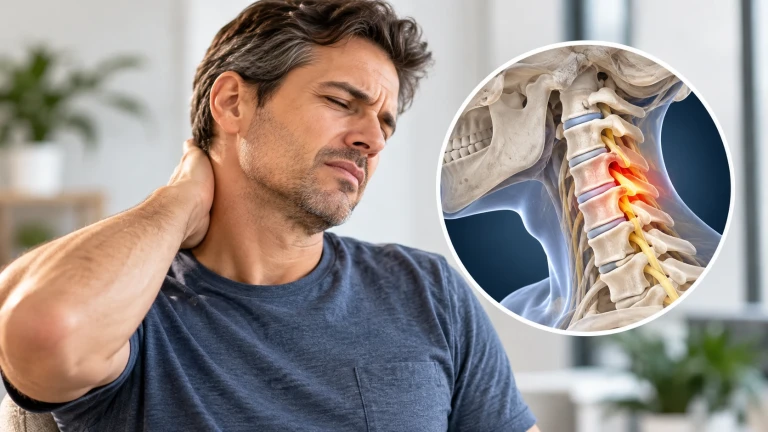
Neck pain is common, but what happens when the discomfort is accompanied by tingling in your hands, weakness in your arms, or difficulty maintaining your balance?
These symptoms may have several causes. One condition healthcare professionals consider is cervical spinal stenosis.
By downloading the Digital Patient Chart mobile app you can better control your patient portal.


Cervical spinal stenosis occurs when the spinal canal in the neck becomes narrower, potentially placing pressure on the spinal cord or nearby nerve roots. Some people have no symptoms, while others develop pain, numbness, weakness, or coordination difficulties.
Understanding this condition is important because not all neck problems are muscular, and certain neurological symptoms require prompt medical attention.
What Is Cervical Spinal Stenosis?
Your cervical spine consists of seven vertebrae, labeled C1 through C7.
Together, these bones help support your head, allow neck movement, and protect the spinal cord.
The spinal cord passes through a central opening called the spinal canal. Nerve roots branch away from the spinal cord and exit through smaller openings between vertebrae.
When these spaces become narrower, nearby nervous system structures may be compressed.
Two related conditions can develop:
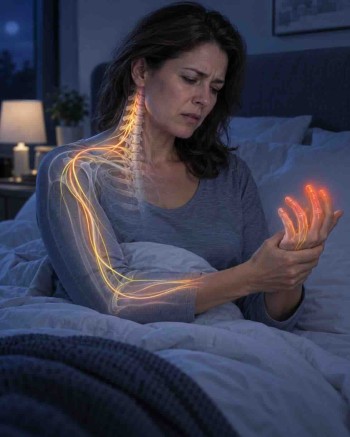
- Cervical radiculopathy: Irritation or compression of a cervical nerve root, potentially causing pain, tingling, numbness, or weakness extending into an arm.
- Cervical myelopathy: Dysfunction caused by pressure on the spinal cord, potentially affecting hand coordination, walking, balance, and strength.
Not everyone with cervical stenosis develops these complications. Some individuals have narrowing visible on imaging without significant symptoms.
The degree of narrowing, location, neurological examination, and symptoms all influence clinical decisions.
What Causes Cervical Spinal Stenosis?
Several structural changes can reduce the available space within the cervical spine.
1. Age-Related Spinal Changes
Aging is one of the most common contributors to acquired cervical stenosis.
Over time, spinal discs can lose height and hydration, while joints and ligaments undergo changes.
These developments can gradually narrow portions of the spinal canal.
2. Bone Spurs
Bone spurs, also called osteophytes, may develop around degenerating spinal joints.
When these bony growths extend toward the spinal canal or nerve openings, they may contribute to compression.
3. Herniated Cervical Discs
A cervical disc contains a softer center surrounded by a tougher outer layer.
When disc material protrudes beyond its normal boundary, it may press against a nerve root or the spinal cord.
4. Thickened Spinal Ligaments
Certain ligaments can become thicker or less flexible with age.
Changes in these structures may further reduce the available space around the spinal cord.
5. Naturally Narrow Spinal Canal
Some people are born with a relatively narrow cervical canal.

This can make them more susceptible to developing symptomatic compression if additional degenerative changes occur.
What Are the Symptoms of Cervical Spinal Stenosis?
Symptoms vary depending on which neurological structures are affected.
Common symptoms may include:
- Neck discomfort or stiffness
- Pain radiating into the shoulders or arms
- Tingling or numbness in the hands
- Arm or hand weakness
- Difficulty gripping objects
- Reduced fine motor coordination
- Unsteadiness while walking
- Balance problems
Some people experience relatively mild discomfort, while others develop significant neurological impairment.
An important distinction is that cervical spinal stenosis does not always cause neck pain.
For example, someone with spinal cord compression may first notice that buttoning clothing has become difficult or that walking feels less steady.
These symptoms should not be dismissed simply because the neck itself feels comfortable.
Why Can a Neck Problem Affect Your Hands and Legs?
The cervical spinal cord contains nerve pathways that connect the brain with much of the body.
When the spinal cord becomes compressed, signals traveling through these pathways may be disrupted.
This explains why cervical myelopathy can produce symptoms beyond the neck.
For example:
Hand symptoms: Difficulty writing, fastening buttons, or manipulating small objects may indicate impaired coordination.
Arm symptoms: Some individuals experience weakness, altered sensation, or reduced dexterity.
Leg symptoms: Spinal cord compression can affect walking, balance, and lower-extremity movement.
These symptoms can also occur with neurological conditions unrelated to cervical stenosis. Proper medical examination is necessary to identify the cause.
What Is the Connection Between the Upper Cervical Spine and Spinal Stenosis?
The upper cervical spine includes the atlas (C1) and axis (C2), located directly beneath the skull.
These vertebrae have distinctive shapes and joint structures that allow important head movements.
The atlas supports the skull, while the axis helps facilitate head rotation.
The upper cervical region also surrounds the spinal cord and contains important ligaments and other anatomical structures.
Although cervical stenosis commonly develops at lower cervical levels, abnormalities or degenerative changes can also affect the upper cervical region.
However, ordinary postural asymmetry or suspected atlas misalignment should not be assumed to cause spinal canal narrowing.
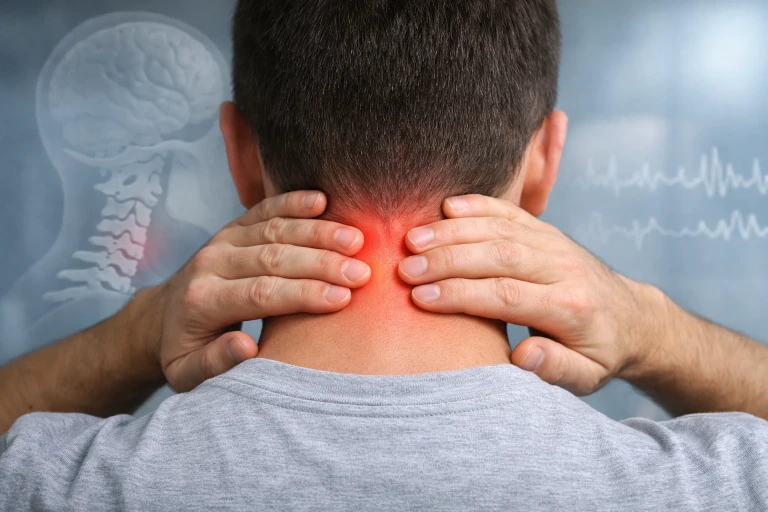
Stenosis is a structural diagnosis that requires appropriate medical assessment and, when indicated, imaging.
Can Upper Cervical Chiropractic Help Cervical Stenosis?
Upper cervical chiropractic focuses on evaluating the anatomy and mechanics of the uppermost cervical region.
This approach may include assessment of neck movement, posture, joint tenderness, relevant neurological findings, and previous injuries.
At UC Spine Care, the Blair Upper Cervical approach emphasizes individualized examination and specific, low-force procedures when clinically appropriate.
However, an important distinction must be made.
Upper cervical adjustments have not been established as a way to widen a narrowed spinal canal, remove bone spurs, reverse a herniated disc, or decompress a compressed spinal cord.
Evidence specifically supporting Blair Upper Cervical Chiropractic as a treatment for cervical spinal stenosis is insufficient.
For a patient with stenosis, chiropractic evaluation should therefore focus on identifying contraindications, recognizing neurological warning signs, and determining whether any coexisting uncomplicated mechanical neck discomfort can be managed conservatively.
Patients with suspected or confirmed cervical myelopathy require medical assessment, often involving a spine specialist.
Cervical manipulation should not be performed when spinal cord compression, instability, or other contraindications make it unsafe.
How Is Cervical Spinal Stenosis Diagnosed?
A clinician usually begins by reviewing symptoms and performing a physical and neurological examination.
This may include evaluation of:
- Muscle strength
- Reflexes
- Sensation
- Hand coordination
- Walking and balance
- Cervical movement
- Previous injuries and medical conditions
Imaging may then be recommended.
MRI
Magnetic resonance imaging is particularly useful for evaluating the spinal cord, intervertebral discs, ligaments, and other soft tissues.
It is commonly used when spinal cord compression or cervical myelopathy is suspected.
CT Scan
Computed tomography provides detailed images of bony structures and can help evaluate bone spurs or other skeletal changes.
X-Rays
X-rays may show alignment and degenerative changes, but they do not directly visualize the spinal cord or establish the full extent of neural compression.
The appropriate test depends on symptoms and clinical findings.
What Are the Treatment Options?
Treatment depends on the severity of stenosis and whether nerve roots or the spinal cord are affected.
Conservative Management
For selected patients without spinal cord dysfunction, clinicians may recommend physical therapy, activity modification, appropriate exercise, or medications.
These approaches may improve symptoms and function, but they do not necessarily reverse the anatomical narrowing.
Medical and Surgical Evaluation
When stenosis causes cervical myelopathy, particularly with progressive neurological impairment, specialist assessment becomes essential.
Surgery may be recommended to relieve spinal cord compression and reduce the risk of further deterioration.
The decision depends on disease severity, examination findings, imaging, and individual risk factors.
Why Early Assessment Matters
Persistent neurological symptoms should not be treated as ordinary muscle tension.
Early recognition of spinal cord compression can help prevent delays in appropriate management.
When Is Cervical Spinal Stenosis Serious?
Certain symptoms may indicate spinal cord involvement and require urgent evaluation.
Warning signs include:
- New or worsening arm or leg weakness
- Increasing difficulty walking
- Frequent loss of balance or falls
- Progressive loss of hand coordination
- New bowel or bladder dysfunction
- Rapidly worsening numbness or neurological function
New bladder or bowel dysfunction, rapidly progressive weakness, or sudden severe neurological symptoms require emergency medical assessment.
Avoid forceful neck manipulation when these symptoms are present.
Frequently Asked Questions About Cervical Spinal Stenosis
Can cervical spinal stenosis go away on its own?
Structural narrowing generally does not disappear spontaneously. Some people experience improvements in symptoms with conservative management, but the anatomical narrowing may remain.
Can cervical stenosis cause headaches?
Neck disorders can coexist with headaches, but headaches alone are not a reliable indicator of spinal stenosis. A clinical evaluation is needed to determine their cause.
Does cervical stenosis always require surgery?
No. Some patients have mild narrowing without significant neurological symptoms and can be monitored or managed conservatively. Patients with spinal cord compression and myelopathy may require surgical evaluation.
Can cervical stenosis affect balance?
Yes. If stenosis compresses the spinal cord, it can interfere with pathways involved in walking and coordination. New or worsening balance problems warrant prompt medical assessment.
Is upper cervical chiropractic safe for someone with spinal stenosis?
Safety depends on the degree and location of narrowing, neurological findings, spinal stability, and the proposed procedure. Spinal cord compression or suspected myelopathy requires medical evaluation, and manipulation may be contraindicated. Upper cervical care should never substitute for necessary neurological or surgical assessment.
What is the difference between cervical stenosis and cervical myelopathy?
Cervical stenosis describes narrowing of the spinal canal. Cervical myelopathy describes spinal cord dysfunction that can occur when the cord becomes compressed. A person may have stenosis without myelopathy.
Understanding Your Cervical Spine Health
Cervical spinal stenosis is more than a potential source of neck discomfort. In certain cases, it can affect the nerves and spinal cord responsible for strength, sensation, coordination, and walking.
Recognizing symptoms early and obtaining an accurate diagnosis are essential.
At UC Spine Care, upper cervical evaluations emphasize individualized assessment of cervical anatomy and mechanical function. When symptoms suggest spinal cord compression or another serious neurological condition, appropriate medical referral takes priority.
If you have ongoing neck discomfort and want to understand whether an upper cervical evaluation is suitable, contact UC Spine Care to discuss your symptoms and the appropriate next steps.
Make an appointment
Medical disclaimer: This article is for general education and does not replace medical diagnosis, neurological evaluation, or treatment. Cervical stenosis involving the spinal cord can be serious. Seek prompt medical care for progressive neurological symptoms.


Leave a comment