

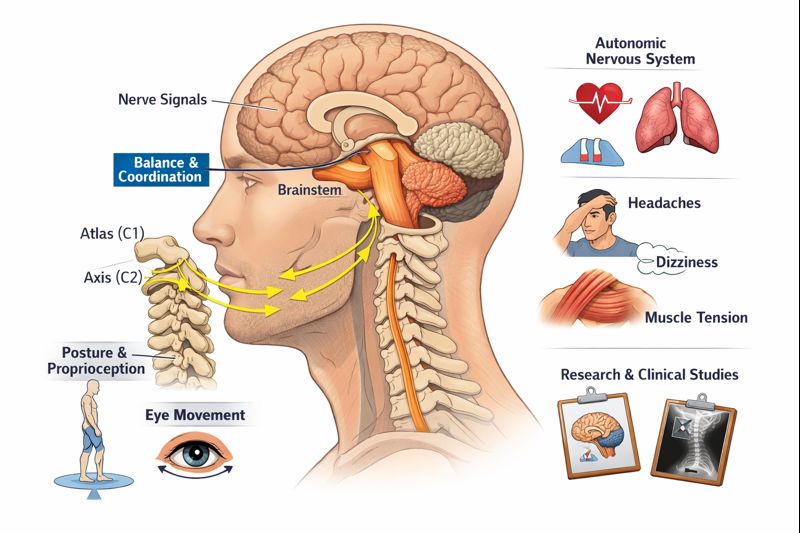
The upper neck plays a much larger role in overall health than most people realize. While it is often associated with neck pain or stiffness, its real influence extends into the nervous system, affecting balance, coordination, muscle tone, and even how the brain interprets information from the body.
Understanding how upper neck mechanics interact with the nervous system helps explain why issues in this area can show up as headaches, dizziness, posture problems, or widespread tension rather than isolated neck pain.
By downloading the Digital Patient Chart mobile app you can better control your patient portal.


Understanding the Upper Neck
The upper cervical spine refers to the top two vertebrae of the neck:
- C1 (atlas)
- C2 (axis)
These vertebrae support the head and allow for fine, precise movements such as nodding and rotation. Unlike the lower neck, the upper neck is designed more for sensory input and coordination than for strength or load-bearing.
Because of this design, small mechanical changes in the upper neck can have outsized effects on the nervous system.
Why the Upper Neck Is Neurologically Important
The upper neck contains one of the highest concentrations of mechanoreceptors in the body. These are specialized sensory receptors that provide the brain with information about:
- Head position
- Movement speed and direction
- Joint alignment
- Muscle length and tension
This sensory input feeds directly into the brainstem, cerebellum, and vestibular system, areas responsible for balance, coordination, eye movement, and autonomic regulation.
When upper neck mechanics function normally, this information is clear and consistent. When mechanics are altered, the nervous system receives distorted signals.
How Mechanical Dysfunction Affects Neural Signaling
Upper neck dysfunction does not usually compress nerves in the traditional sense. Instead, it alters signal quality.
Related article

Upper Cervical Chiropractic to the Rescue: A Natural Solution for Neck Pain
Aug 17, 2025Common mechanical issues include:
- Joint restriction or hypomobility
- Poor segmental alignment
- Muscle guarding or asymmetry
- Repetitive postural strain (forward head posture, prolonged screen use)
These changes affect how sensory information travels from the neck to the brain. When input becomes inconsistent, the nervous system compensates.
Compensation may involve:
- Increased muscle tone for stability
- Altered balance strategies
- Changes in eye-head coordination
- Heightened sensitivity or fatigue
Over time, this can create symptoms that appear unrelated to the neck.
Symptoms Commonly Linked to Upper Neck Dysfunction
Because the nervous system integrates signals globally, upper neck issues can present in multiple ways, including:
- Headaches or head pressure
- Dizziness or unsteadiness
- Neck stiffness with limited rotation
- Jaw tension or facial discomfort
- Shoulder and upper back tightness
- Visual strain or difficulty focusing
- Postural fatigue
These symptoms are often intermittent and may fluctuate with stress, posture, or workload.
Research Supporting the Neck–Nervous System Connection
Multiple research areas support the relationship between upper neck mechanics and nervous system function:
Cervicocephalic Proprioception
Studies show that altered sensory input from upper cervical joints can affect balance and spatial orientation. This helps explain why neck dysfunction is associated with dizziness even when the inner ear is normal.

Sensorimotor Integration
Neuroscience research demonstrates that inaccurate joint input disrupts how the brain integrates movement and posture, leading to compensation patterns throughout the body.
Headache and Neck Mechanics
Clinical studies link restricted upper cervical mobility with certain headache patterns, especially those originating from musculoskeletal sources rather than vascular or neurological disease.
Autonomic Nervous System Influence
The upper cervical region lies close to brainstem structures involved in autonomic regulation, which may explain associations with symptoms such as lightheadedness or fatigue in some individuals.
Why Pain Is Not Always the First Signal
Upper neck dysfunction often develops gradually. Because the nervous system prioritizes stability and function, it may compensate silently for long periods.
Instead of pain, early signs may include:
- Reduced neck range of motion
- Subtle balance changes
- Increased muscle tension
- Postural shifts
Pain often appears later, once compensation capacity is exceeded.
Clinical Evaluation of Upper Neck Mechanics
A proper evaluation focuses on function, not just symptoms. This may include:
- Segmental motion assessment
- Postural analysis
- Range-of-motion testing
- Neuromuscular coordination checks
- Functional movement observation
The goal is to determine how mechanical input from the upper neck is influencing the nervous system over time.
Restoring Healthy Input to the Nervous System
Care approaches aimed at the upper neck typically focus on:

- Improving joint mobility
- Reducing abnormal muscle tone
- Restoring symmetrical movement
- Enhancing proprioceptive accuracy
When mechanical input improves, the nervous system often responds by reducing unnecessary compensation.
This process emphasizes adaptation and regulation, not symptom suppression.
Why This Matters for Long-Term Health
The nervous system relies on clear, consistent information to regulate movement, posture, and stability. When upper neck mechanics are impaired, the system adapts, but adaptation is not always efficient.
Addressing mechanical input early helps maintain:
- Better movement coordination
- Lower physical stress
- Improved postural endurance
- More efficient neuromuscular control
When to Seek a Professional Evaluation
An evaluation may be appropriate if there is:
- Persistent neck stiffness without a clear injury
- Recurrent headaches linked to posture or movement
- Balance changes without ear pathology
- Ongoing upper body tension resistant to exercise alone
A qualified musculoskeletal or spine-focused clinician can determine whether upper neck mechanics are contributing to these patterns.
If neck tension, headaches, balance changes, or postural fatigue are part of daily life, an assessment of upper neck mechanics may provide useful insight.
A clinical evaluation can help determine how mechanical input from the upper neck is influencing nervous system function and whether targeted care is appropriate.
If you have questions, contact our office



Leave a comment