

A rear-end collision can change how your neck moves, how its muscles communicate with your brain, and how your head maintains balance—even when initial imaging appears normal.
Whiplash is often described as the head snapping backward and forward during a car accident. But the actual mechanics are more complicated.
By downloading the Digital Patient Chart mobile app you can better control your patient portal.


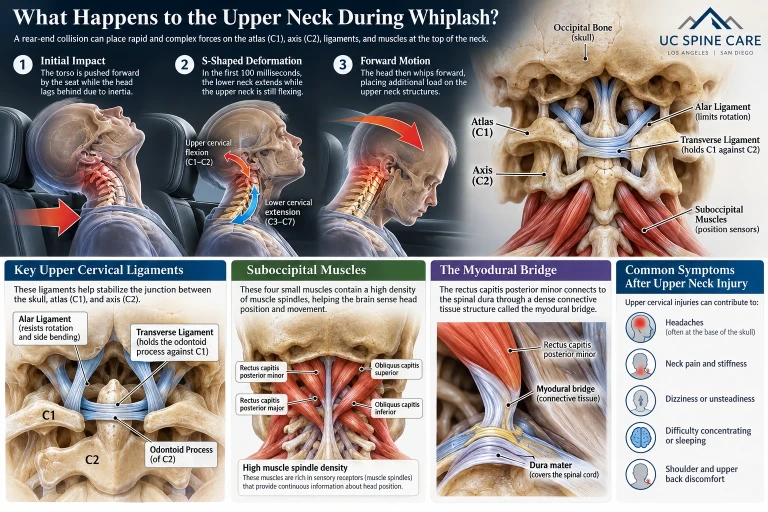
During a sudden acceleration-deceleration injury, different parts of the cervical spine can move in different directions within fractions of a second. This places mechanical stress on the joints, muscles, and ligaments supporting the head.
The upper cervical spine, consisting of the atlas (C1) and axis (C2), deserves particular attention because it contributes to head movement, joint stability, and sensory information used for balance and coordination.
Understanding these structures helps explain why some people experience persistent neck pain, headaches, stiffness, or dizziness following a collision.
What Happens to the Cervical Spine During a Rear-End Collision?
When another vehicle strikes your car from behind, the seat pushes your torso forward while your head initially lags behind because of inertia.
This creates an unusual sequence of cervical movement.
Rather than bending smoothly backward, the neck can temporarily form an S-shaped curve.
During this phase:
- The lower cervical vertebrae move into extension.
- The upper cervical vertebrae remain in relative flexion.
- The joints and supporting tissues experience rapidly changing mechanical loads.
- The head subsequently moves backward and then forward.
Biomechanical studies show that this deformation develops very early in a rear-impact event.
The concern is not simply how far the head moves. It is how rapidly the individual cervical segments move relative to one another.
This can place stress on tissues that normally stabilize the neck during controlled movement.
Why Are the Atlas (C1) and Axis (C2) Important?
The upper cervical spine contains two specialized vertebrae.
The atlas (C1) supports the skull and contributes significantly to nodding movements.
The axis (C2) contains the odontoid process, a bony projection around which the atlas rotates.
Together, these vertebrae form an essential part of the connection between the head and spine.
They also surround the upper spinal cord and sit near important neurological and vascular structures.
Unlike the lower cervical vertebrae, C1 and C2 have distinctive anatomy that allows substantial mobility while relying on specialized ligaments for stability.
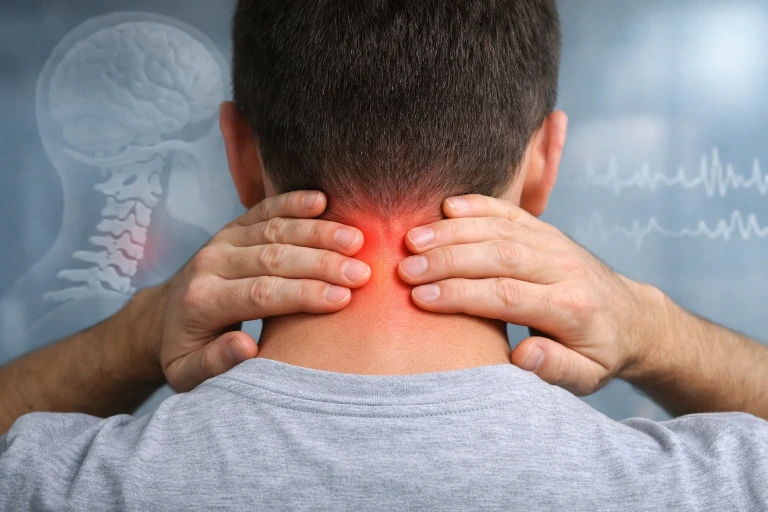
After trauma, evaluating this region may be appropriate when symptoms, examination findings, or the injury mechanism suggest upper cervical involvement.
However, whiplash does not automatically mean the atlas has shifted out of position or that the upper cervical ligaments have been damaged.
How Can Whiplash Affect the Upper Cervical Ligaments?
Two important ligament systems help stabilize the relationship between the skull, atlas, and axis.
The transverse ligament helps hold the odontoid process of C2 against the atlas, limiting excessive forward movement of C1.
The alar ligaments connect the odontoid region to the skull and help restrict excessive rotation and side bending.
These structures provide passive stability during head movement.
Severe trauma can damage upper cervical ligaments, potentially creating instability. However, clinically significant instability is not a routine finding in uncomplicated whiplash.
When ligament injury is suspected, appropriate medical assessment and imaging are essential.
Importantly, a normal X-ray does not visualize every soft-tissue injury. At the same time, persistent symptoms alone cannot establish that a ligament is torn or a joint is unstable.
The Suboccipital Muscles: Your Neck's Hidden Position Sensors
Just beneath the skull lies a group of four small muscles known as the suboccipital muscles:
- Rectus capitis posterior major
- Rectus capitis posterior minor
- Obliquus capitis superior
- Obliquus capitis inferior
Although these muscles help move and stabilize the head, they also perform an important sensory function.
They contain unusually high concentrations of muscle spindles, specialized receptors that detect changes in muscle length and movement.
These receptors help your brain determine where your head is positioned relative to your body.
This sensory process is called proprioception.
Following a neck injury, pain, muscle guarding, altered movement, and disrupted proprioceptive processing may affect coordination between the neck, eyes, and balance systems.
Researchers continue to investigate how these changes contribute to persistent symptoms after whiplash.
What Is the Myodural Bridge, and Why Does It Matter?

One of the upper neck's most interesting anatomical features is the myodural bridge.
This connective tissue structure links certain suboccipital muscles, including the rectus capitis posterior minor, with the spinal dura.
The dura is the protective membrane surrounding the spinal cord.
Anatomical research confirms that this connection exists.
Scientists have proposed that the myodural bridge may help regulate dural tension during head movement.
However, its precise contribution to headaches, dizziness, and post-traumatic symptoms remains under investigation.
Its existence does not establish that every whiplash injury causes dural irritation.
Nevertheless, the structure demonstrates how closely the upper cervical muscles and protective tissues of the nervous system are anatomically connected.
Why Can Whiplash Cause Headaches, Dizziness, and Neck Pain?
Whiplash-associated disorders can involve several structures and physiological processes simultaneously.
Common symptoms include:
- Neck stiffness and restricted movement
- Headaches, particularly near the base of the skull
- Shoulder and upper back discomfort
- Dizziness or unsteadiness
- Increased sensitivity to movement
- Difficulty concentrating or sleeping
Upper cervical muscles and joints can contribute to certain neck-related headaches.
Altered cervical proprioception may also contribute to dizziness in some patients.
However, dizziness following an accident can have other causes, including concussion, vestibular injury, medication effects, or, rarely, vascular injury.
For this reason, symptoms should not automatically be attributed to C1 or C2 dysfunction.
Can You Have a Whiplash Injury Even When Your MRI Is Normal?
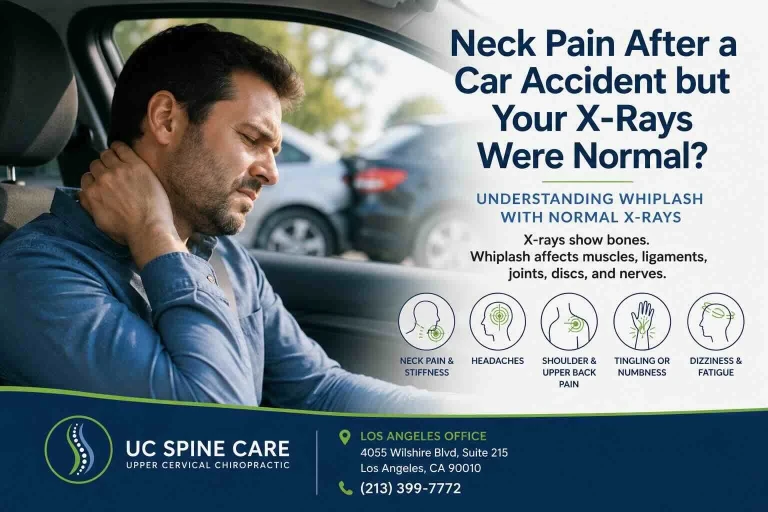
Yes. A person can experience whiplash-associated pain and functional limitations despite normal findings on routine imaging.
X-rays primarily assess bones and alignment. MRI provides more information about soft tissues, discs, and neurological structures.
Neither test identifies every source of pain or functional impairment.
Imaging decisions should be guided by clinical findings, injury severity, and established medical criteria.
Specialized imaging is not routinely necessary for uncomplicated whiplash.
When serious injury is suspected, medical clearance is necessary before cervical manipulation or other neck-directed treatment.
How Can Upper Cervical Chiropractic Care Fit Into Recovery?
At UC Spine Care, the clinical focus includes the upper cervical spine, particularly the atlas and axis.
The practice uses the Blair Upper Cervical Chiropractic Technique, an approach emphasizing individualized assessment and targeted cervical adjustments.
For patients recovering from whiplash, the first priority is determining whether symptoms suggest a serious injury that requires medical evaluation.
Once serious injury has been excluded, conservative treatment may help address selected musculoskeletal complaints.
Evidence-supported whiplash management generally emphasizes education, gradual return to normal activities, appropriate exercise, and rehabilitation.
Upper cervical chiropractic care may be considered as part of an individualized treatment plan, but evidence has not established that Blair adjustments repair torn ligaments, correct every case of dizziness, or reliably reverse post-traumatic neurological symptoms.
Frequently Asked Questions About Upper Cervical Whiplash Injuries
Can whiplash injure the C1 and C2 vertebrae?
Yes. Significant trauma can affect the joints, ligaments, and surrounding tissues of the upper cervical spine. However, many whiplash injuries involve other cervical levels, and C1-C2 damage should not be assumed without examination.
Why do headaches develop after a car accident?
Headaches may result from neck-related pain, muscle tension, concussion, migraine activation, or other injuries. Persistent or worsening headaches require appropriate medical evaluation.
Can upper neck injuries affect balance?
They can contribute to altered sensory input involved in balance, but dizziness has multiple possible causes and requires careful assessment.
When should I seek emergency care?
After neck trauma, seek urgent medical assessment for severe or worsening neck pain, new weakness or numbness, difficulty walking, fainting, vision or speech changes, or a sudden severe headache.
Understanding Your Neck Is the First Step Toward Recovery
Whiplash is more than a simple backward-and-forward movement of the head.
It can involve complex mechanical loading, protective muscle responses, and changes in how the cervical spine controls movement.
The atlas, axis, stabilizing ligaments, suboccipital muscles, and proprioceptive system all play important roles in upper neck function.
Recognizing these relationships supports a more informed approach to evaluating persistent symptoms.
Experiencing neck discomfort or headaches after a car accident?
Contact the office to discuss your symptoms, available evaluation options, and whether upper cervical care may be appropriate after medical clearance.
San Diego: (619) 786-0231
Medical disclaimer: This article is for educational purposes and does not replace individualized medical diagnosis or treatment.
References
Panjabi et al. — Cervical Spine Curvature During Simulated Whiplash. Supports the S-shaped cervical deformation discussion.
Suboccipital Muscles, Forward Head Posture, and Cervicogenic Dizziness. Reviews muscle spindles, proprioception, and proposed dizziness mechanisms.
Orientation and Property of Fibers of the Myodural Bridge in Humans. Provides anatomical evidence for the myodural bridge.
Cervical Sprain — NCBI Bookshelf. Reviews whiplash diagnosis, imaging, and evidence-based management.
Leave a comment