

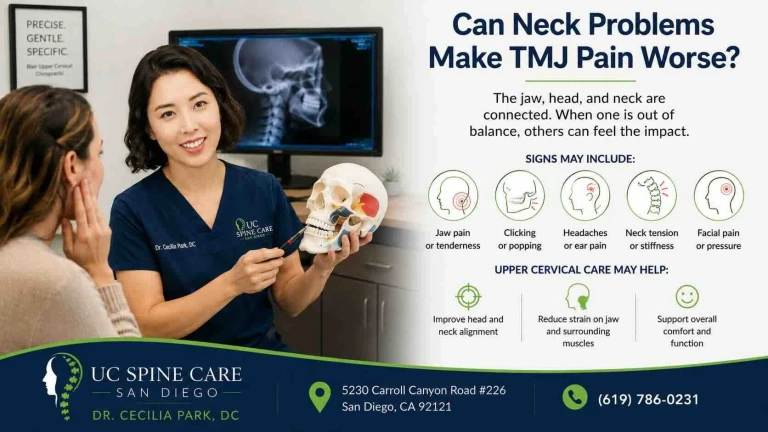
You bite into something firm and feel the familiar click.
Maybe there is pain just in front of your ear. Maybe your jaw feels tight first thing in the morning. By the end of the day, the tension has spread toward your temple and down the side of your neck.
By downloading the Digital Patient Chart mobile app you can better control your patient portal.


You massage the jaw.
Then the neck.
For a little while, everything settles.
The next morning, it starts again.
When jaw discomfort and neck tension keep appearing together, it is reasonable to wonder whether they are actually connected.
For some patients, they may be.
How the Jaw and Neck Can Be Connected
The temporomandibular joints sit just in front of the ears and connect the lower jaw to the skull.
TMJ is the name of the joint itself. TMD, or temporomandibular disorder, is the broader term for conditions that cause pain or dysfunction involving the jaw joint and surrounding muscles. Common symptoms include pain in the jaw or chewing muscles, stiffness, painful clicking or popping, and difficulty with normal jaw movement.
The jaw does not function independently from the rest of the head.
Every time you chew, speak, yawn, or swallow, muscles around the jaw, skull, and neck have to coordinate.
That is one reason someone with jaw pain may also notice:
- Tightness along the side of the neck
- Headaches around the temples
- Pain near the ear
- Difficulty opening the mouth comfortably
- Clicking or popping while chewing
- A tired jaw after talking or eating
- Neck or shoulder tension occurring with jaw symptoms
Having both neck pain and TMD does not prove that one caused the other. It does suggest that evaluating both regions may provide a more complete picture.
What Recent Research Found
A 2024 study looked specifically at people with painful temporomandibular disorders and examined both jaw and cervical function.
Researchers found that people with greater jaw and neck pain also showed impairments involving muscle strength, cervical joint-position sense, jaw function, and postural stability. The authors concluded that the connection between the jaw and cervical region is clinically important when assessing people with painful TMD.
That finding should not be stretched too far.
It does not mean that correcting the neck will automatically eliminate TMJ pain.
It does reinforce a practical point: when jaw pain and cervical symptoms occur together, treating them as completely unrelated problems may overlook part of the picture.
Why Head Position May Matter
Think about how your jaw rests when you are looking straight ahead.
Now push your head several inches forward, the way many people sit while looking at a laptop or phone.
Your jaw did not suddenly develop a new disease. But the relationship between the skull, neck muscles, and lower jaw has changed.
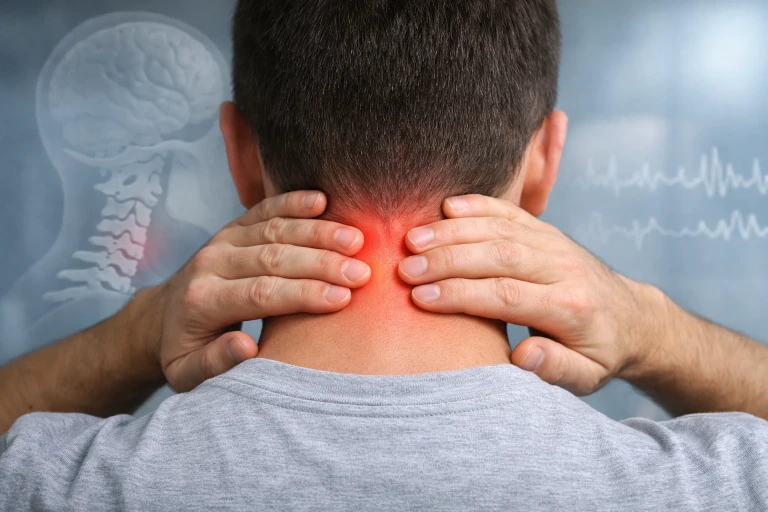
The muscles now have to work within a different mechanical position.
For a healthy person, that may mean very little.
For someone whose jaw is already irritated, who clenches at night, or who has an old cervical injury, changes in head and neck mechanics may add another layer of strain.
That is why Dr. Cecilia Park’s evaluation does not need to begin with the assumption that “the problem is the atlas.”
It begins with a better question:
What is happening throughout the system?
What If Your Jaw Clicks but Does Not Hurt?
A jaw sound by itself does not always mean treatment is necessary.
The National Institute of Dental and Craniofacial Research notes that jaw sounds without pain are common and generally do not require treatment.
The situation changes when clicking occurs with pain, locking, limited opening, facial discomfort, or difficulty chewing.
For example:
You open your mouth and hear a click.
No pain. No problem eating. No locking.
That is very different from:
You open your mouth, the jaw shifts sideways, pain shoots toward your ear, and you can barely bite into a sandwich.
Symptoms matter more than sound alone.
Could Clenching Be Part of the Problem?
It can.
Many people tighten their jaw without realizing it, especially during concentration or sleep.
The morning often tells the story.
You wake up with tired chewing muscles. The temples feel sore. Your jaw feels as though it has already worked an eight-hour shift before breakfast.
Now add neck stiffness.
It becomes difficult to know where one problem stops and the other begins.
A dentist may evaluate tooth wear, bite-related issues, or possible nighttime clenching. An upper cervical chiropractor evaluates a different piece of the problem: cervical mechanics, head position, movement, previous neck trauma, and whether the upper cervical region is functioning normally.
Those evaluations can complement each other rather than compete.
What About an Old Whiplash Injury?
Previous trauma is worth discussing when jaw and neck symptoms began around the same time.
A rear-end collision can rapidly move the head and cervical spine. Some people also clench the jaw during impact.
That does not prove that an old accident caused today's TMJ disorder.
But if the jaw began clicking after a collision, the neck never regained full motion, and one side has remained tight ever since, that history deserves attention.
Patients sometimes forget about an accident because it happened ten years ago.
The body does not organize medical history according to calendar convenience.
Past injuries are simply pieces of information that may—or may not—help explain the present pattern.
Where the Upper Cervical Spine Fits
The atlas and axis, C1 and C2, sit directly below the skull.
This region plays an important role in supporting and positioning the head. It is also mechanically close to the jaw, skull, and many muscles involved in head and neck control.
At UC Spine Care San Diego, Dr. Cecilia Park specializes in the Blair Upper Cervical Chiropractic Technique. The practice describes Blair care as a precise, gentle approach that uses detailed imaging and individualized measurements rather than forceful twisting, popping, or rapid neck manipulation.
When examining a patient with jaw symptoms, the purpose is not to declare every TMJ disorder an upper cervical problem.
Instead, Dr. Park can evaluate whether cervical mechanics appear to be one contributing factor alongside the jaw itself.
What Dr. Cecilia Park May Look For
The history often provides some of the most useful clues.
Questions may include:
When did the jaw pain begin?
Does the jaw click or lock?
Does one side hurt more?
Did the symptoms begin after an accident?
Do headaches occur at the same time?
Is neck movement restricted?
Does turning or positioning the head change the jaw tension?
Has a dentist already evaluated the jaw?
Then the upper cervical examination can look at head position, cervical movement, neurological findings, and the relationship of the upper cervical joints.
When clinically appropriate, UC Spine Care uses CBCT imaging to study the individual bony anatomy of the upper cervical region and help plan Blair analysis.
Upper Cervical Care Is Not a Replacement for Dental Care
This distinction matters.
Temporomandibular disorders include more than one type of problem. Some involve the joint itself. Others involve chewing muscles, disc mechanics, arthritis, or other conditions. The exact cause is not always clear.
Related article

Upper Cervical Chiropractic to the Rescue: A Natural Solution for Neck Pain
Aug 17, 2025A dentist, oral-health professional, physician, or TMJ specialist may need to evaluate persistent jaw symptoms.
Upper cervical care addresses a different question:
Is cervical dysfunction contributing to the overall mechanical pattern?
Sometimes the answer may be yes.
Sometimes it may be no.
That is why examination should come before conclusions.
When Jaw Pain Needs Prompt Attention
Seek appropriate medical or dental care when jaw pain follows significant facial trauma, when the jaw becomes locked open or closed, or when swelling, infection, fever, or rapidly worsening symptoms are present.
Pain around the jaw can also occasionally come from a source other than the TMJ.
New jaw discomfort associated with chest pressure, shortness of breath, sweating, or exertion should be treated as a medical concern rather than assumed to be a TMJ problem.
Frequently Asked Questions
1. Can a neck problem cause jaw pain?
The neck and jaw can influence one another, and research has found cervical impairments in patients with painful TMD. That does not mean every case of jaw pain starts in the neck.
2. Why do my jaw and neck hurt at the same time?
The jaw, skull, and cervical spine share muscular and neurological relationships. Clenching, posture, injury, muscle guarding, and TMD may all contribute to symptoms appearing in both areas.
3. Can TMJ problems cause headaches?
Yes. TMD can be associated with headaches and facial pain. NIDCR recognizes headaches associated with TMD among the condition classifications.
4. Does every clicking jaw need treatment?
No. Jaw clicking or popping without pain is common and may not require treatment. Pain, locking, restricted opening, or impaired function makes evaluation more important.
5. Can an upper cervical adjustment cure TMJ?
Current evidence does not justify promising a cure. Blair Upper Cervical care may be considered when cervical dysfunction appears to be contributing to the patient's overall pattern, while dental or medical care may address the TMJ itself.
TMJ and Upper Cervical Evaluation in San Diego
Jaw pain has a way of sneaking into ordinary moments.
Breakfast becomes uncomfortable.
A long conversation tires your face.
Yawning requires a little caution.
Then you notice the neck is always tight too.
At that point, looking only at the exact spot that hurts may not tell the whole story.
For patients whose jaw symptoms occur alongside neck tension, headaches, restricted head movement, or a history of injury, evaluating the cervical spine may provide another useful part of the answer.
UC Spine Care — San Diego
Dr. Cecilia Park, DC
5230 Carroll Canyon Road #226
San Diego, CA 92121
Phone: (619) 786-0231
Dr. Park specializes in Blair Upper Cervical Chiropractic care with an emphasis on individualized analysis and precise, low-force correction.
Medical note: This article is educational and does not diagnose or treat temporomandibular disorders. Jaw pain can have dental, muscular, joint, neurological, or other causes. Appropriate dental or medical evaluation should be obtained when indicated.
Leave a comment