


You turn your head to back out of a parking spot and hear it: a pop, a click, or a gritty sound like gravel under a shoe. Some people pop their own necks dozens of times a day because the release feels like the only thing that helps.
An occasional pop is normal. A neck that constantly pops, grinds, or feels like it needs to be popped is telling you something. At UC Spine Care, Dr. Cecilia Park hears this from patients at both our Koreatown office in Los Angeles and our Sorrento Valley office in San Diego, usually from people who have been popping their own neck for years.
By downloading the Digital Patient Chart mobile app you can better control your patient portal.


What Is Actually Making the Sound?
Most neck pops come from the small facet joints on the back of each vertebra. These joints are filled with lubricating fluid. When a joint is stretched quickly, the pressure inside drops and a gas bubble forms, producing the familiar pop. A 2015 MRI study that filmed joints popping in real time showed exactly that: a cavity forming inside the joint fluid at the moment of the sound.
That's why you can't pop the same joint again right away. The joint needs time to reset before it can pop again.
Other sounds have other sources. Clicking or snapping can come from tendons and ligaments sliding over bone. A gritty, grinding sound, called crepitus, can come from roughened joint surfaces as the neck ages.
Why Do I Feel the Urge to Pop It?
This is the part most people never question. The urge usually comes from a stiff, tight feeling in one area of the neck. Twisting your head until something pops brings a few minutes of relief, then the tightness comes back.
The problem is that when you twist your own neck, the joints that move are usually the ones that already move easily, not the one that feels stuck. Over time, the loose joints get looser and the stiff area stays stiff. That's why the urge keeps returning, sometimes several times an hour.
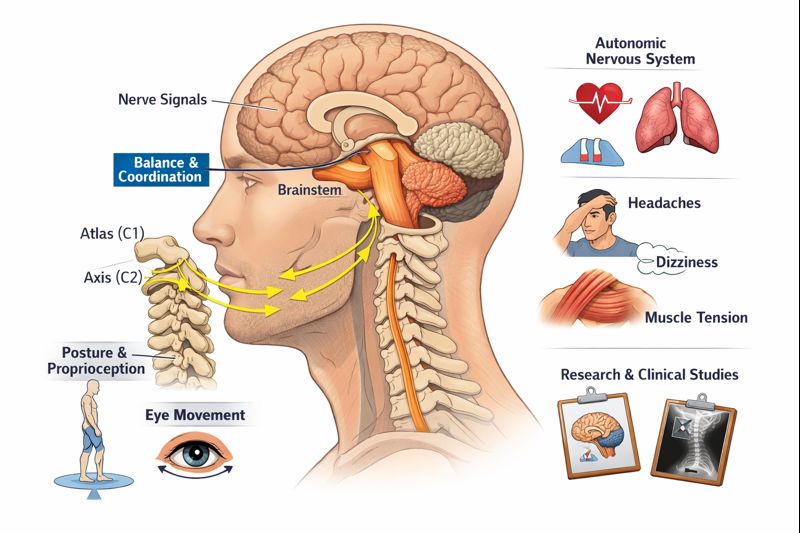
In many people, the tight spot traces back to the top of the neck. When the atlas, the top vertebra, shifts out of position, the muscles around it guard to keep your head level. That guarding creates the stiff, "needs to pop" feeling lower in the neck.
Is Popping My Neck Bad for Me?
An occasional gentle pop is harmless, and there's no good evidence that joint popping causes arthritis. Frequently and forcefully popping your own neck is a different story. It keeps stretching joints and ligaments that are already loose. Rare but serious injuries to the arteries in the neck have also been reported after sudden, forceful twisting.
If you find yourself reaching for your head many times a day, that's a reason to find out why, not a habit to keep feeding.

When Is Neck Popping a Warning Sign?
Get checked promptly if popping or grinding comes with:
Pain that is getting worse, or that began after a fall, car accident, or sports injury
Numbness, tingling, or weakness in the arms or hands
A sudden, severe neck pain or headache, especially right after twisting the neck
Call 911 for sudden dizziness, vision changes, slurred speech, facial drooping, or trouble walking.
How Dr. Park Approaches a Neck That Keeps Popping
Instead of adding more popping, Dr. Park looks for the reason the neck feels stuck. Blair technique analysis uses detailed imaging to measure the three-dimensional alignment of the atlas and axis, since everyone's upper neck joints are shaped a little differently. The correction is precise and gentle, without any twisting or forceful rotation, and no popping is needed for it to work.
Patients from Hancock Park and Mira Mesa are often surprised by how quiet the adjustment is. Many also notice that as the upper neck holds its correction, the urge to pop their neck fades on its own.
A Simple Check Before Your Visit
For three days, keep a tally every time you pop your neck or feel the urge to. Note where the tight spot is and which direction you twist. If the number is high and the spot is always the same, bring the tally to your first appointment. It's a useful map of where your neck is compensating.
Frequently Asked Questions
1. Is it normal for my neck to pop when I turn my head?
Yes. An occasional pop or click with movement is common and usually harmless, especially without pain. Constant popping, grinding, or popping with pain deserves an exam.
2. Why does my neck pop but never feel better for long?
Popping your own neck usually moves the joints that are already loose rather than the stiff one causing the tight feeling, so the relief fades within minutes.
3. Can popping my neck cause a stroke?
It's rare, but injuries to the arteries of the neck have been reported after sudden, forceful twisting. Avoid aggressively popping your own neck, and call 911 for sudden dizziness, vision changes, slurred speech, or trouble walking.
4. Does upper cervical chiropractic pop your neck?
No. The Blair technique used at UC Spine Care corrects the upper neck without twisting, popping, or forceful rotation.
5. Why does my neck grind?Grinding, or crepitus, often comes from roughened joint surfaces or soft tissue moving over bone. It's common with age, but grinding with pain or after an injury should be evaluated.
Ready to find out why your neck keeps needing to pop?
Schedule an appointment with Dr. Cecilia Park at UC Spine Care. Call our Los Angeles office at (213) 399-7772, 4055 Wilshire Blvd #215, Los Angeles, CA 90010, or our San Diego office at (619) 786-0231, 5230 Carroll Canyon Rd #226, San Diego, CA 92121.


Leave a comment