

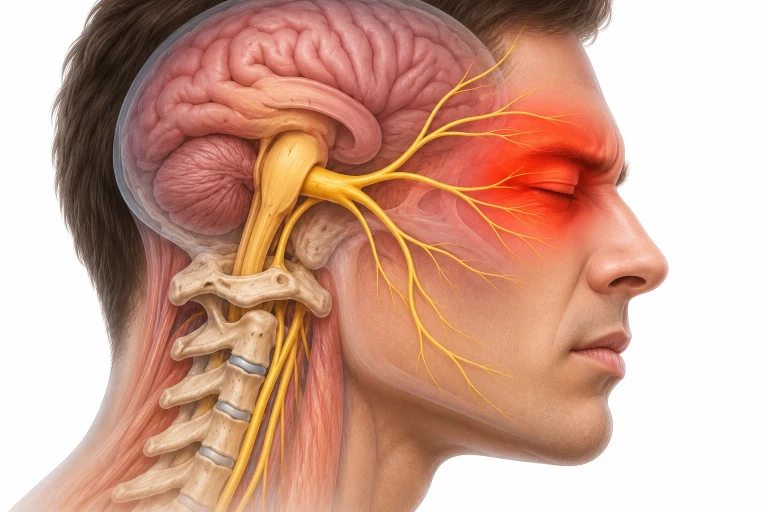
Cluster headaches are among the most painful neurological headache disorders. They can develop suddenly, interrupt sleep, interfere with work, and significantly affect a person's quality of life.
For individuals experiencing recurring headaches alongside neck discomfort, exploring the relationship between the upper cervical spine and nervous system may provide additional insight.
By downloading the Digital Patient Chart mobile app you can better control your patient portal.


At Upper Cervical Spine Care in Los Angeles, Dr. Cecilia Park specializes in Blair Upper Cervical Chiropractic, a gentle, targeted approach focused on the relationship between spinal function and neurological health.
While upper cervical chiropractic is not an established treatment for cluster headaches, addressing associated cervical dysfunction may play a complementary role in a comprehensive healthcare plan.
What Are Cluster Headaches?
Cluster headaches are a primary neurological headache disorder characterized by extremely intense pain, typically affecting one side of the head around the eye or temple.
Unlike ordinary headaches, cluster headaches occur in recurring patterns known as cluster periods, which may last several weeks or months.
Untreated attacks typically last between 15 and 180 minutes and can occur multiple times throughout the day or night.
Common symptoms of cluster headaches include:
- Severe, penetrating pain around one eye.
- Pain concentrated on one side of the head.
- Excessive tearing or redness of the affected eye.
- Nasal congestion or a runny nose.
- Drooping or swelling of the eyelid.
- Facial sweating.
- Restlessness and agitation.
- Recurring attacks during similar times of the day.
Some individuals also experience neck stiffness, muscle tension, or discomfort near the base of the skull.
What Causes Cluster Headaches?
Cluster headaches involve complex neurological mechanisms associated with the hypothalamus, trigeminal nerve, and autonomic nervous system.
The hypothalamus helps regulate the body's internal clock, sleep patterns, hormonal activity, and other physiological processes. Its involvement may help explain why cluster headache attacks frequently occur at predictable times.
The trigeminal nerve is responsible for transmitting sensory information from the face and head to the brain. Activation of trigeminal pain pathways plays a significant role in cluster headache symptoms.
Researchers continue to investigate the precise mechanisms behind this condition. Although upper cervical dysfunction can coexist with cluster headaches, spinal misalignment has not been established as their underlying cause.
The Connection Between Cluster Headaches and the Upper Cervical Spine

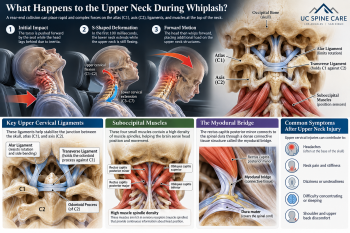
The upper cervical spine consists of the first two cervical vertebrae:
- Atlas (C1): Supports the skull and facilitates head movement.
- Axis (C2): Allows rotational movement of the head and neck.
These vertebrae are located near the brainstem and upper spinal cord, surrounded by muscles, ligaments, blood vessels, and sensory nerves.
An important neurological region called the trigeminocervical complex receives sensory information from both the trigeminal nerve and upper cervical spinal nerves.
This convergence helps explain why certain neck-related pain conditions can produce discomfort in the head, forehead, temples, and areas surrounding the eyes.
Previous injuries, restricted cervical movement, prolonged postural stress, and muscle tension may contribute to additional pain signals originating from the neck.
For individuals with cluster headaches and accompanying cervical discomfort, evaluating the upper cervical spine may help identify a separate musculoskeletal source of pain.
How Upper Cervical Chiropractic Care May Help
Upper cervical chiropractors use specific techniques designed to address mechanical dysfunction involving the atlas and axis vertebrae.
At UC Spine Care in Los Angeles, the Blair Upper Cervical Technique focuses on individualized assessment and precise adjustments without conventional forceful neck twisting.
Potential objectives of upper cervical care include:
1. Improving Upper Cervical Joint Function
Restricted movement in the upper cervical spine can contribute to muscular compensation and mechanical discomfort.
Specific upper cervical adjustments may help improve joint mobility and reduce associated neck symptoms in appropriately selected patients.
2. Supporting Healthy Neurological Communication
The upper cervical spine provides continuous sensory information to the central nervous system.
Addressing mechanical dysfunction may influence how pain-related sensory information is processed. However, research has not established that chiropractic adjustments restore disrupted nerve transmission responsible for cluster headaches.
3. Reducing Neck Tension and Mechanical Irritation
Persistent muscle tension around the upper neck and base of the skull can contribute to discomfort and restricted movement.

Conservative cervical care may help address these mechanical stressors and support more comfortable movement.
4. Supporting the Body's Natural Recovery Processes
The body possesses natural mechanisms for tissue recovery, pain regulation, and adaptation.
By addressing relevant musculoskeletal dysfunction, upper cervical care aims to create more favorable conditions for comfortable movement and physical recovery.
Claims that atlas adjustments directly reduce cluster headache-related neurological inflammation or repair nerve damage require further scientific investigation.
Cluster Headaches vs. Cervicogenic Headaches
Although cluster headaches and cervicogenic headaches can produce pain around the head and eyes, they are distinct conditions.
Cluster headaches originate from neurological mechanisms and often involve severe eye pain, tearing, nasal symptoms, and predictable attack patterns.
Cervicogenic headaches originate from structures within the cervical spine and are frequently associated with restricted neck movement, stiffness, and pain triggered by specific head positions.
A person may experience both conditions simultaneously.
Identifying the correct headache classification is essential for developing an appropriate treatment plan.
What Does Research Say About Chiropractic Care and Headaches?
A 2022 systematic review published in Chiropractic & Manual Therapies examined manual and exercise therapy across 20 studies involving 1,439 patients with cervicogenic headaches.
The findings suggested that these interventions may reduce headache intensity, frequency, and disability in some patients.
A subsequent 2026 systematic review also found that manual therapy may provide short-term relief for cervicogenic headaches, although long-term benefits remain uncertain.
These findings support investigating cervical dysfunction when neck-related headaches are suspected. However, they cannot be directly generalized to cluster headaches.
Current evidence-based cluster headache treatments include prescribed oxygen therapy, triptans, and preventive medications such as verapamil. Chiropractic care should not replace these treatments or ongoing neurological evaluation.
What to Expect at UC Spine Care in Los Angeles
Dr. Cecilia Park uses the Blair Upper Cervical Technique to evaluate each patient's individual spinal anatomy and mechanical function.

Your initial assessment may include:
- A detailed medical, headache, and injury history.
- Upper cervical spinal examination.
- Assessment of posture and cervical mobility.
- Diagnostic imaging when clinically justified.
- Individualized upper cervical adjustments when appropriate.
- Follow-up evaluations to monitor functional changes.
Cervical adjustments are not suitable for every patient. Treatment decisions should consider individual risks, medical findings, and alternative approaches.
Frequently Asked Questions
Can upper cervical chiropractic help cluster headaches?
Upper cervical chiropractic may help address accompanying neck pain and cervical dysfunction. However, sufficient clinical evidence demonstrating that it prevents or resolves cluster headaches is currently lacking.
Can atlas misalignment cause cluster headaches?
Atlas misalignment has not been established as a cause of cluster headaches. The condition involves complex neurological pathways associated with the hypothalamus and trigeminal nerve.
Can neck problems trigger headache pain behind the eyes?
Yes. Certain cervical disorders can produce referred pain around the eyes through connections between upper cervical and trigeminal sensory pathways.
Is Blair Upper Cervical Chiropractic gentle?
The Blair technique uses targeted adjustments based on individual anatomy without conventional forceful neck rotation. Like other forms of spinal manipulation, it carries potential risks that should be discussed before treatment.
When should I seek medical attention?
New or recurring severe headaches require medical evaluation. Seek emergency care for sudden, extremely severe headaches accompanied by neurological changes, vision loss, fever, weakness, confusion, or difficulty speaking.
Explore Upper Cervical Chiropractic Care in Los Angeles
Living with cluster headaches can be physically and emotionally exhausting. When persistent neck tension, stiffness, or restricted movement accompanies your headaches, a comprehensive upper cervical evaluation may help identify additional factors affecting your well-being.
At Upper Cervical Spine Care, Dr. Cecilia Park provides individualized Blair Upper Cervical Chiropractic care in the Koreatown neighborhood of Los Angeles.
Schedule a consultation to discover whether upper cervical care is an appropriate addition to your healthcare plan.
Upper Cervical Spine Care – Los Angeles
Dr. Cecilia Park, DC
4055 Wilshire Blvd, Suite 215
Los Angeles, CA 90010
Phone: (213) 399-7772
Website: https://ucspinecare.com

Leave a comment