

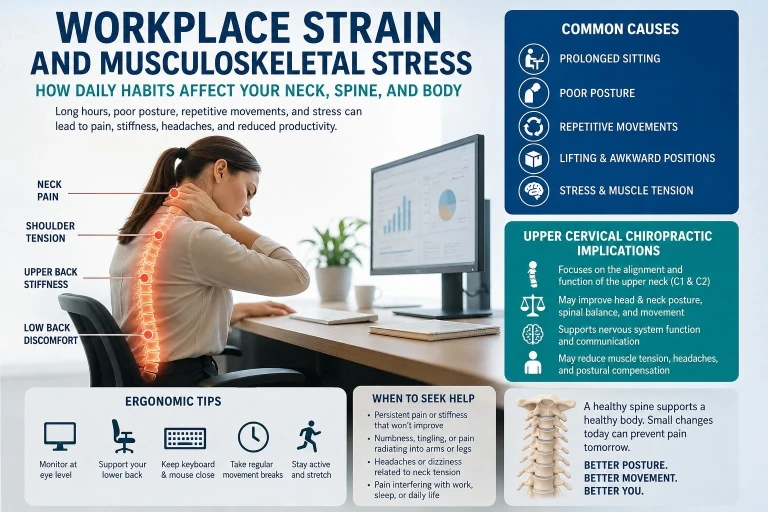
Workplace strain is one of the most common but overlooked reasons people develop neck pain, upper back tension, headaches, shoulder discomfort, low back stiffness, and general musculoskeletal stress.
For many people, these symptoms do not begin with one major injury. They build slowly from repeated postures, long hours at a desk, poor workstation setup, repetitive movements, lifting demands, stress, and limited recovery.
By downloading the Digital Patient Chart mobile app you can better control your patient portal.


Musculoskeletal conditions affect muscles, joints, ligaments, tendons, nerves, and spinal structures.
According to the World Health Organization, low back pain is the leading contributor to the global burden of musculoskeletal conditions, with hundreds of millions of people affected worldwide.
In the workplace, the problem is not only pain. It can affect productivity, concentration, sleep, movement, and quality of life.
For patients searching online for answers to workplace neck pain, desk posture pain, tech neck, upper back tightness, headaches from work, or chiropractic care for work-related strain, it is important to understand one key point: the body adapts to the positions and stresses it experiences most often.
What Is Workplace Strain?
Workplace strain refers to physical stress placed on the body during job-related activities. This may include sitting for long periods, looking down at a phone or computer, repetitive hand or arm movements, lifting, reaching, twisting, standing on hard surfaces, or working in awkward positions.
The National Institute for Occupational Safety and Health explains that ergonomics focuses on designing work tasks to fit the worker and reduce discomfort and injury risk. OSHA also notes that proper ergonomics can help lessen muscle fatigue and reduce the number and severity of work-related musculoskeletal disorders.
This matters because many workplace symptoms are not random. They often follow predictable patterns.
A person who spends hours looking down may develop neck tension. A person who sits without lumbar support may develop low back stiffness.
A person who types with raised shoulders may develop upper trapezius tightness.
A person who lifts repeatedly with poor mechanics may experience spinal or hip strain.
Common Symptoms of Musculoskeletal Stress at Work
Workplace-related musculoskeletal stress can show up in different ways, including:
- Neck stiffness or pain
- Upper back tightness
- Shoulder tension
- Headaches or pressure around the head
- Low back pain
- Hip tightness
- Wrist, elbow, or hand discomfort
- Numbness, tingling, or radiating symptoms
- Muscle fatigue
- Reduced range of motion
- Pain that worsens during or after the workday

Some people notice symptoms only after a long day. Others wake up stiff because their body never fully recovers from the previous day’s strain. Over time, these patterns can become more persistent.
Why Desk Work Can Create So Much Physical Stress
Desk work may look physically easy, but it can place a steady load on the spine and supporting muscles. Sitting for long periods often encourages forward head posture, rounded shoulders, shallow breathing, and reduced spinal movement.
Mayo Clinic describes “tech neck” as chronic neck or shoulder pain, soreness, or stiffness related to poor posture while using phones, computers, or other devices. Looking down at screens can strain the neck muscles and encourage the shoulders to slump forward.
The issue is not simply posture. It is time under tension. Even a mild forward head position can become stressful when held for hours every day.
Muscles that are designed to move and stabilize begin to guard. Joints become stiff. The upper back loses mobility. The neck works harder to support the head.
This is why someone may say, “I only sit at a computer, but my neck and back feel exhausted.”
The Role of Repetition, Lifting, and Awkward Positions
Workplace strain is not limited to office employees. Healthcare workers, warehouse workers, drivers, hairstylists, mechanics, teachers, dental professionals, construction workers, and service workers can all experience musculoskeletal stress.
Repetitive movements, forceful exertion, awkward postures, mechanical pressure, and vibration are recognized risk factors associated with musculoskeletal disorders. These stresses may affect the spine, shoulders, elbows, wrists, hips, knees, and feet.
A worker who lifts all day may overload the low back. A dental professional who leans over patients may develop neck and upper back strain.
A driver may experience hip and lumbar stiffness from prolonged sitting. A hairstylist may develop shoulder and wrist tension from repetitive arm positions.
The body is highly adaptable, but adaptation has a limit. When physical demands exceed recovery, symptoms begin.
How Workplace Stress Affects the Nervous System

Musculoskeletal stress is not only a muscle issue. The spine and nervous system are closely connected. The neck, especially the upper cervical region, contains important joints, muscles, ligaments, and nerve pathways involved in posture, balance, head position, and communication between the brain and body.
When the neck is exposed to sustained postural strain, the surrounding muscles may tighten to protect the area. This can limit motion and contribute to compensation patterns throughout the spine.
A stiff upper neck may influence how the shoulders move. A guarded upper back may affect breathing and posture. A stressed low back may change how the hips and legs function.
This is where upper cervical chiropractic care may be relevant.
Upper Cervical Chiropractic Implications
Upper cervical chiropractic focuses on the alignment, motion, and function of the upper neck, especially the area where the head meets the spine. This region plays an important role in head posture, spinal balance, and nervous system function.
For someone dealing with workplace strain, an upper cervical chiropractor may evaluate:
- Head and neck posture
- Upper cervical alignment
- Range of motion
- Muscle tension patterns
- Shoulder and upper back compensation
- Neurological signs related to balance, coordination, or nerve irritation
How daily work habits may be contributing to stress on the spine
The goal is not simply to “crack the neck.” A careful upper cervical approach looks at whether dysfunction in the upper neck may be contributing to recurring tension, headaches, neck stiffness, or postural compensation.
When the upper cervical spine is not moving or functioning well, the body may compensate below that area. This can create strain through the shoulders, mid-back, and even the lower spine.
For patients who feel like stretching, massage, or workstation changes help only temporarily, a deeper spinal evaluation may be appropriate.
Upper cervical chiropractic care may be one part of a broader plan that includes ergonomic changes, movement breaks, strengthening, stretching, hydration, sleep support, and stress management.
Why Ergonomics Still Matters
Chiropractic care should not ignore the environment that created the problem. If a patient receives care but returns to the same workstation, same posture, and same daily stress without change, symptoms may continue to return.
Related article

Balancing Your Body: The Transformative Power of Upper Cervical Chiropractic for Your Posture
Jan 19, 2025Helpful changes may include placing the monitor at eye level, keeping feet supported, relaxing the shoulders, positioning the keyboard and mouse close to the body, using a chair that supports the natural curve of the low back, and taking short movement breaks throughout the day.
Small changes done consistently can reduce daily strain.
When to Seek Professional Help
Occasional stiffness may improve with rest, movement, and ergonomic changes. However, professional evaluation is recommended when symptoms persist, worsen, interfere with sleep, radiate into the arms or legs, cause numbness or tingling, or repeatedly return after temporary relief.
A chiropractic evaluation can help determine whether spinal joint restriction, upper cervical dysfunction, posture imbalance, muscle guarding, or nerve irritation may be contributing to the problem.
In some cases, referral for imaging or medical evaluation may be necessary, especially if symptoms are severe or associated with weakness, trauma, fever, unexplained weight loss, or loss of bowel or bladder control.
The Bigger Picture: Work Should Not Break the Body
Workplace strain is common, but it should not be ignored. Pain is often the body’s way of asking for change.
The answer may include a better workstation, improved movement habits, stronger postural support, more frequent breaks, and professional care when the spine and nervous system are under stress.
Upper cervical chiropractic offers a focused way to evaluate how the head, neck, and spine are adapting to daily work demands.
For patients dealing with neck pain, upper back tightness, headaches, posture-related discomfort, or recurring musculoskeletal stress, the upper cervical region may be an important part of the clinical picture.
The goal is not only to reduce pain. The goal is to help the body function better during the activities people repeat every day.
Sources
Centers for Disease Control and Prevention / NIOSH: Ergonomics and Work-Related Musculoskeletal Disorders.
CDC / NIOSH: About Ergonomics and Work-Related Musculoskeletal Disorders.
World Health Organization: Musculoskeletal Health.
OSHA: Ergonomics Overview.



Leave a comment