

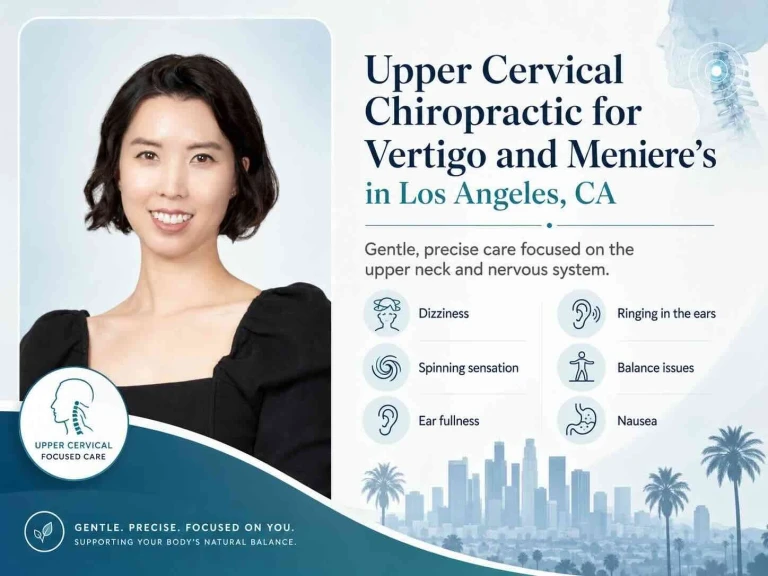
Vertigo is not just dizziness. Anyone who has experienced a true vertigo episode knows the difference.
The room does not just feel unsteady — it spins. The floor tilts. Standing up becomes a calculated risk. Driving is out of the question. And when it passes, the fear of the next episode moves in and does not leave.
By downloading the Digital Patient Chart mobile app you can better control your patient portal.


For people living with Meniere's disease, that fear is a daily companion. The unpredictable attacks of intense spinning vertigo, the ringing in the ears, the fluctuating hearing loss, the feeling of fullness or pressure deep inside the ear — it is a condition that dismantles normal life in ways that are difficult to explain to anyone who has not experienced it.
In Los Angeles, where life moves fast and stopping is not really an option, Meniere's disease and chronic vertigo are conditions that demand real answers.
At Los Angeles Chiropractic Office on Wilshire Boulevard, upper cervical chiropractic care is offering those answers to patients who have exhausted the conventional options without finding lasting relief.
What Is Meniere's Disease and Why Is It So Difficult to Treat
Meniere's disease is a disorder of the inner ear characterized by episodic vertigo, tinnitus, a sensation of ear fullness, and progressive hearing loss. It is classified as a chronic condition with no known conventional cure.
Standard medical management focuses on reducing the frequency and severity of attacks through dietary modifications, diuretics, vestibular suppressant medications, and in more severe cases, injections or surgical procedures targeting the inner ear.
The problem with that treatment framework is that it addresses the inner ear as an isolated system. It manages the symptoms of Meniere's without adequately explaining or addressing why the inner ear is malfunctioning in the first place.
That is where the upper cervical spine enters the picture — and where a significant body of research suggests the conventional framework has been missing something important.
The Upper Cervical Connection to Vertigo and Meniere's Disease
The relationship between the upper cervical spine and inner ear function is anatomical, not theoretical. The atlas vertebra — C1, sitting directly beneath the skull — influences the inner ear through several distinct mechanisms that are increasingly well understood.
Related article
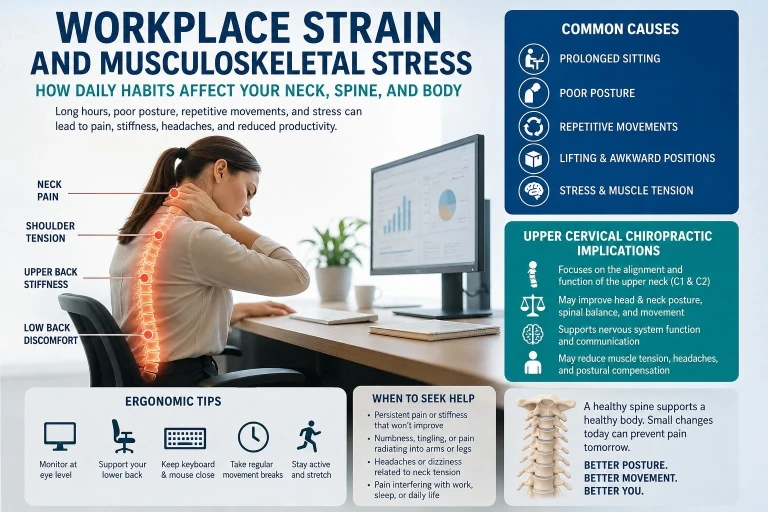
Workplace Strain and Musculoskeletal Stress: How Daily Work Habits Affect the Neck, Spine, and Body
May 16, 2026The Eustachian tubes, responsible for regulating pressure and fluid drainage in the middle and inner ear, pass in close proximity to the upper cervical musculature.
When the atlas is displaced and the surrounding muscles tighten asymmetrically, Eustachian tube function is compromised. Fluid accumulates. Pressure builds. The endolymphatic system — the fluid-filled compartments of the inner ear — becomes dysregulated. That dysregulation is the physiological hallmark of Meniere's disease.
The brainstem, surrounded by the atlas ring, also plays a direct role in vestibular processing. Balance signals from the inner ear are processed in the brainstem before being interpreted by the brain.
When atlas misalignment places mechanical stress on the brainstem, those signals are distorted at the processing level — producing vertigo, spatial disorientation, and balance instability that originates not in the inner ear itself but in the neural environment surrounding it.
Cerebrospinal fluid dynamics add another layer. The craniocervical junction — the structural interface between the skull and the atlas — is a critical point in the circulation of cerebrospinal fluid. Atlas displacement can impair that circulation, creating pressure differentials that affect inner ear fluid regulation.
The Research That Changed How This Connection Is Understood
The most significant research on the upper cervical-Meniere's connection comes from Dr. Michael Burcon, a chiropractor whose work with Meniere's patients produced findings that the conventional medical community has been slow to acknowledge but cannot easily dismiss.
In a study presented at the American Chiropractic Association conference and subsequently published, Dr. Burcon documented that the vast majority of Meniere's disease patients in his practice had a history of significant head or neck trauma — most commonly whiplash from a car accident — an average of eleven years before their Meniere's diagnosis.
That eleven-year gap is critical. It explains why patients and physicians alike fail to connect the structural injury to the eventual diagnosis. A rear-end collision on the 10 freeway in 2012 does not feel related to the vertigo attacks that began in 2023. But the atlas displacement from that accident, slowly disrupting inner ear fluid dynamics and brainstem function over the intervening years, may be exactly the link.
In Dr. Burcon's study, upper cervical correction produced significant improvement in vertigo frequency and severity in the majority of patients. For a condition that conventional medicine manages but rarely resolves, those outcomes are worth taking seriously.
Why Los Angeles Patients With Vertigo Often Go Undiagnosed at the Structural Level
Related article

Are You Suffering From Fibromyalgia? Upper Cervical Chiropractic May Be the Answer
Dec 02, 2022Los Angeles is a city with significant traffic density, a high rate of auto accidents, and a population that absorbs physical trauma regularly — on freeways, at the gym, on construction sites, on film and television sets.
The cumulative and acute trauma that comes with urban Los Angeles life creates meaningful risk for atlas displacement that the standard healthcare system never screens for.
When a Los Angeles patient presents with vertigo or Meniere's symptoms, the standard referral pathway goes to an ENT or neurologist. Audiological testing, MRI, vestibular function testing — all of these evaluate the inner ear and brain in isolation.
None of them evaluate the structural position of the atlas. None of them measure the precision misalignment that upper cervical care identifies and corrects.
So patients on Wilshire Boulevard, in Koreatown, in Mid-Wilshire, across the Westside — they get diagnoses that describe their symptoms without explaining their cause.
They get medications that suppress the vertigo without resolving the structural problem producing it. And they come to accept a diminished life as the price of a condition that may have a correctable structural component nobody has looked for.
What the Evaluation Looks Like at Los Angeles Chiropractic Office
The first appointment begins with a detailed health history. For vertigo and Meniere's patients, Dr. Campbell pays particular attention to:
- The timeline of symptom onset and any preceding head or neck trauma
- The specific pattern of vertigo episodes — frequency, duration, triggers, accompanying symptoms
- Previous treatments tried and their outcomes
- Any history of ear infections, pressure changes, or prior vestibular diagnoses
Precision upper cervical imaging follows. Cone beam computed tomography produces a three-dimensional reconstruction of the atlas and axis, measuring their position relative to the skull with a level of accuracy that standard imaging cannot approach.
For patients whose conventional workups have returned normal results, this imaging frequently identifies the structural picture that has been missing from their diagnosis.
Objective neurological testing adds further data before any correction is considered:
- Paraspinal infrared thermography identifies asymmetric autonomic nervous system activity along the cervical spine
- Postural and leg length analysis documents the compensatory pattern built around the atlas displacement
- No correction is delivered until the objective findings support it — the restraint-based, data-driven approach is particularly important for patients with active vestibular symptoms
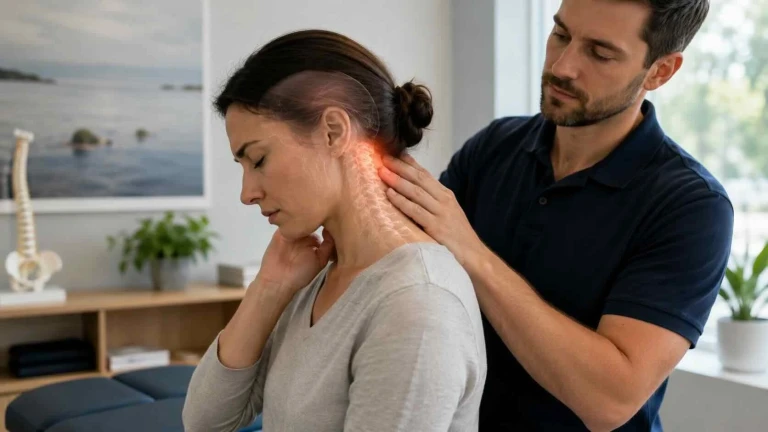
The correction itself is gentle and precise. No rotation of the neck, no cracking, no aggressive manipulation. For patients already dealing with vestibular sensitivity and autonomic dysregulation, the low-force, specific nature of upper cervical correction is not just preferable — it is the clinically appropriate standard.
What Vertigo and Meniere's Patients Experience After Care Begins
Recovery is rarely linear, and honest practitioners say so. The inner ear fluid dynamics and brainstem function that have been disrupted — sometimes for years — do not normalize overnight after a single atlas correction. What most patients notice first is a change in the pattern of their episodes:
- Vertigo attacks become less frequent before they become less severe
- The duration of episodes shortens progressively
- The warning sensations — ear fullness, tinnitus changes — become more predictable and less intense
- Balance and spatial orientation between episodes gradually improve
For some patients, particularly those whose Meniere's onset followed a clear traumatic event and who have not had the condition for many years, the improvement is more substantial.
Patients who have been largely housebound by unpredictable vertigo attacks and who regain the ability to drive, work, and socialize describe upper cervical correction as the first intervention that addressed something structural rather than just suppressing symptoms.
Vertigo Does Not Have to Define Your Life in Los Angeles
Meniere's disease and chronic vertigo carry a particular cruelty — they are invisible conditions. From the outside, a person looks fine. On the inside, they are managing constant uncertainty about when the next attack will come, quietly restructuring their life around a condition most people around them do not understand.
The upper cervical spine is a part of that picture that deserves evaluation before accepting a lifetime of symptom management as the only option. The anatomy is real. The research is real.
And for patients in Los Angeles who have not had their atlas evaluated, that evaluation is a non-invasive, data-driven starting point that costs nothing to pursue and may change everything.
Los Angeles Chiropractic Office is located at 4055 Wilshire Blvd #215, Los Angeles, CA 90010.
Call (213) 399-7772 to schedule a consultation. If vertigo or Meniere's disease has been controlling your life and conventional treatment has not been enough, the structural evaluation is where the next answer may be waiting.

Leave a comment